Why are some domain names available for just a few dollars while others are sold for thousands—or even millions?
The answer isn't simply the domain extension.
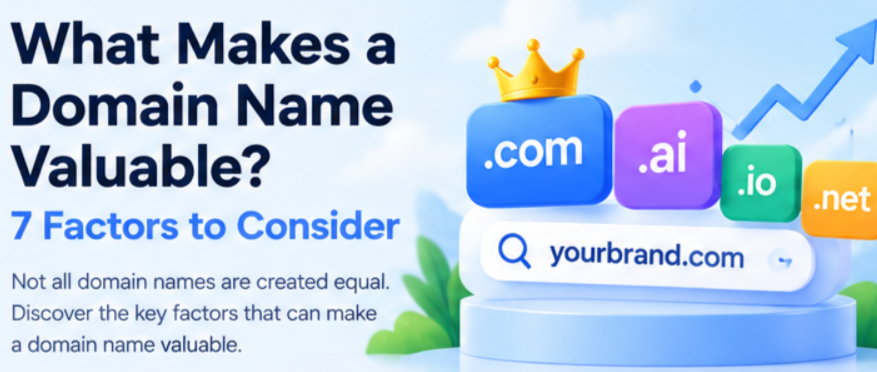
A domain name can become a valuable digital asset when it combines several characteristics that businesses, startups, investors, and consumers find useful.
While there is no universal formula for determining the value of a domain, there are several factors that consistently matter.
If you're just getting started with domain registration, you may also want to read 10 Things to Check Before Registering a Domain Name for a practical checklist before purchasing a domain.
Here are seven things to consider when evaluating a domain name.
1. Length
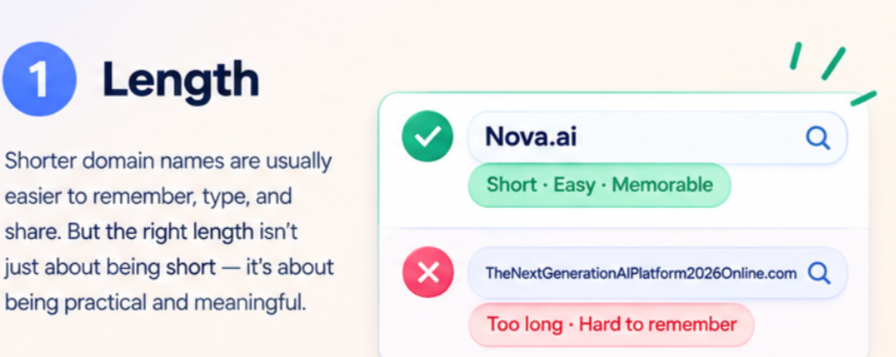
In the domain market, shorter names are often easier to remember and easier to use as brands.
Compare:
Nova.ai
with:
TheNextGenerationAIPlatform.com
The first name is much easier to remember, type, and communicate.
Short domains are also limited in supply. Once a short, meaningful name has been registered, it may only become available through resale.
However, shorter doesn't automatically mean better.
A short domain with no clear meaning may be less useful than a slightly longer domain that communicates a strong brand concept.
The goal is not simply to find the shortest possible name.
It's to find a name that is short enough to be practical and meaningful enough to be memorable.
2. Brandability
Brandability is one of the most important factors when evaluating a domain.
A brandable domain should ideally be:
Consider how the name looks and sounds when used as a company name.
Would it look natural on a logo?
Would someone remember it after hearing it once?
Could it represent a product rather than just describe one?
These questions are often more important than simply counting the number of characters.
3. The Domain Extension
The extension can have a significant impact on how people perceive a domain.
.com remains one of the most widely recognized domain extensions and is used by businesses across almost every industry.
At the same time, newer extensions have developed strong associations with particular industries.
For example:
-
.ai → artificial intelligence and technology
-
.io → startups and technology
-
.org → organizations and communities
-
.shop → ecommerce
-
.dev → developers and technology
This doesn't mean one extension is universally better than another.
The right choice depends on the purpose of the website and the brand.
For an AI startup, for example, a strong .ai domain may be particularly relevant.
For a general business, .com may provide broader recognition.
4. Keyword Relevance
Some domain names contain words that clearly describe a business, product, or industry.
For example:
CloudSecurity.com
TravelGuide.com
MarketingTools.com
A relevant keyword can make the purpose of a website immediately understandable.
However, keyword domains aren't automatically valuable.
The keyword needs to be commercially useful, memorable, and relevant to an actual audience.
There's also an important distinction between a keyword domain and a brand domain.
A keyword domain describes what a business does.
A brand domain creates a unique identity.
Both approaches can work.

5. Demand and Scarcity
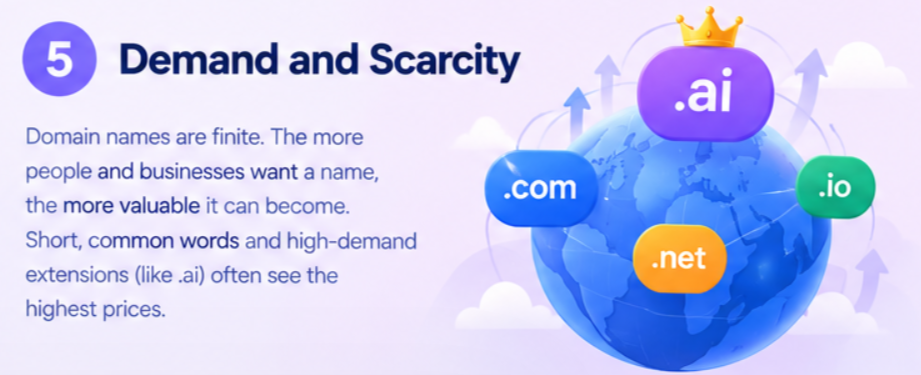
Domain names are finite digital assets.
There is only one exact version of a domain such as:
Example.com
If it is already registered, someone else cannot simply create another identical domain.
This creates scarcity.
The more people or businesses who want a particular name, the more valuable that name can potentially become.
This is one reason short, common words can command high prices on the secondary domain market.
The .ai market provides a good example.
As artificial intelligence became a major technology category, demand increased for short and memorable .ai domains.
Some premium .ai domains have subsequently sold for six-figure prices.
But scarcity alone isn't enough.
A rare domain with little demand may still have limited value.

6. Commercial Potential
Another question to ask is:
Could a real business build a brand around this domain?
Domains connected to large or growing industries may attract more interest because there are more potential buyers.
Technology, finance, healthcare, ecommerce, cybersecurity, AI, and other major categories can create strong demand for relevant names.
For example, a short domain that could work for multiple companies may have a larger potential buyer pool than a highly specific name that only makes sense for one type of business.
This is one reason generic words can be attractive in the domain market.
A word like “Speed” can potentially work across many industries.
A very narrow phrase may have a much smaller audience.

7. Memorability
A domain can be short and still be difficult to remember.
Memorability is about how easily people can recognize and recall the name.
Think about the first time someone hears your domain.
Can they remember it later?
Can they type it without asking for the spelling?
Does it sound natural when spoken?
This matters because domains are often shared verbally, through social media, podcasts, videos, presentations, advertisements, and conversations.
A memorable domain can reduce friction across all of these channels.
Why Some Domains Become Extremely Expensive
When several of these factors come together, a domain can become a premium digital asset.
Imagine a domain with:
There may be many companies interested in such a name, but only one company can own the exact domain.
That combination of quality + demand + scarcity is what can push prices far beyond normal registration fees.
This is why a premium domain can sell for $10,000, $100,000, or even more while another domain using the same extension may cost only a standard registration fee.
Does a .com or .ai Domain Automatically Have More Value?
Not necessarily.
The extension is only one part of the equation.
A strong .ai domain can be highly relevant to an AI company, while a strong .com domain may be more suitable for a general consumer brand.
For example:
Brand.ai
could make sense for an AI-focused startup.
Meanwhile:
Brand.com
could provide broader positioning for a company that may expand into different products and industries.
The value depends on the complete combination of the name, extension, brand potential, demand, and intended use.
If you're deciding between different extensions, 10 Things to Check Before Registering a Domain Name also covers how to evaluate .com, .ai, .io, and other extensions before registering.
How to Evaluate a Domain Before Registering It
If you're considering registering a domain, you don't need to be a professional domain investor.
Start with a simple evaluation.
Ask yourself:
Is it easy to remember?
If someone sees the name once, could they recall it later?
Is it easy to spell?
Avoid unnecessary confusion whenever possible.
Does it fit the brand?
A domain should make sense for the business or project you're building.
Is there real demand for the concept?
A name connected to a useful product, industry, or broad concept may have more commercial potential.
Is the extension appropriate?
Choose an extension that matches the project's audience and positioning.
Could the name grow with the business?
Avoid choosing a name that unnecessarily limits future expansion.
Is the price reasonable?
Don't evaluate a domain based only on its registration price. Consider renewal costs and, if applicable, aftermarket pricing.
Registration Price vs. Domain Value
One common mistake is assuming that a domain's registration price tells you what the domain is worth.
It doesn't.
A newly available domain may cost a standard registration fee simply because nobody has registered it yet.
A premium domain that someone already owns can have a completely different price based on its perceived market value.
For example, a newly registered domain might cost only a few dollars for the first year, while an already-registered premium domain could be offered for thousands of dollars.
These are two different markets.
Understanding this distinction can help you make better decisions when searching for a domain.
For more practical advice on the buying process, see 10 Things to Check Before Registering a Domain Name.
Where Can You Search for a Domain?
Once you've developed a name idea, the next step is checking whether the domain is available.
Rayname is a domain registrar that allows users to search for and register domain names across different extensions.
For example, if the .com version of a name isn't available, you can explore other relevant extensions such as .ai, .io, or others that may fit the project.
Rayname also currently offers new .com registrations for $6.99 for the first year, with a listed renewal price of $11.65 per year.
When comparing registrars, however, it's always worth looking beyond the introductory price and checking the full renewal cost and available domain management features.
Final Thoughts
There isn't a single formula that determines the value of a domain name.
The most useful way to think about domain value is as a combination of several factors:
Memorability + brandability + relevance + demand + scarcity + extension + commercial potential
Not every short domain will become valuable.
Not every .ai domain will sell for six figures.
And not every business needs a premium domain.
For most new projects, the goal is much simpler: find a domain that is memorable, relevant, affordable, and capable of growing with your brand.
A good domain doesn't have to be expensive.
It just needs to make sense for what you're building.
If you're ready to start searching, you can use the checklist in 10 Things to Check Before Registering a Domain Name before making your final decision.


