The headline number
The second quarter of 2026 closed with 401.6 million domain name registrations across all top-level domains (TLDs), according to the latest Domain Name Industry Brief (DNIB), published by Verisign. That's an increase of 9.1 million domains, or 2.3%, over Q1 2026 — and up 8.1% year over year.
Strip out the noise and one fact stands out: the .com and .net TLDs together held 179.1 million registrations at the end of Q2 2026. That works out to roughly 45% of every registered domain on the internet sitting under those two legacy extensions alone.
That share is older than most of the startups registering domains today. It is not, however, shrinking.
Why .com still matters in 2026
Critics have been predicting the decline of .com for over a decade. New gTLDs like .ai, .app, .dev, and .xyz have had their moments. Country-code TLDs have grown. Yet the data keeps pointing the other way:
1. Users default to .com. Typing from memory, most people append .com to a brand name whether that's where the site lives or not. If you launch on .io and someone types yourbrand.com, you're sending that traffic to someone else's property.
2. .com carries trust. In usability studies, users consistently rate .com as more established and more credible than newer extensions. That perception compounds — people link to .coms more, type them more, and search them more.
3. It's a global default, not a regional one. A .com works in Berlin, Lagos, São Paulo, and Tokyo. Country-code TLDs and trendy gTLDs don't.
4. Supply is finite. Every short, pronounceable, dictionary-word .com has already been registered. That scarcity is exactly why the secondary market has stayed active while new-registration pricing has collapsed.
Two paths to a .com
The 179.1 million number breaks down into two very different buyer behaviors:
Path A — Registering a fresh .com
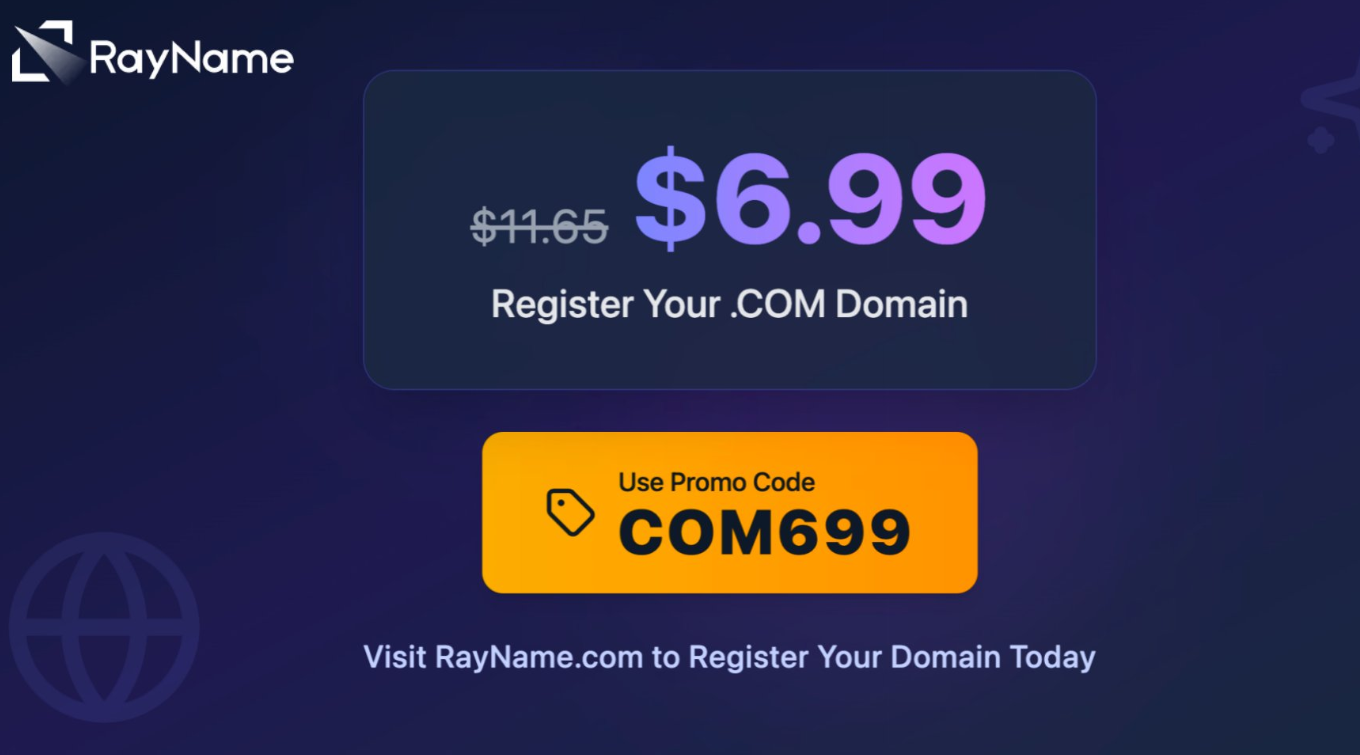
For a new project, a personal site, or a side project, you register a name nobody owns yet. This is where pricing competition has been fiercest. Intro offers under $10 have become standard, and at rayname we currently register new .coms at $6.99 with free WHOIS privacy and instant setup.
What actually matters on this path:
- Pick a name short enough to say out loud once and have someone type it right.
- No hyphens, no numbers, no spellings you have to explain.
- Turn on WHOIS privacy so your registrant contact doesn't get scraped.
- Compare the renewal price, not just the intro price.
Browse available .coms at $6.99 →
Path B — Buying a premium .com
If the short, brandable, dictionary-word .com for your category is already taken, you're in the secondary market. Names like these trade at flat "buy-it-now" prices, and they move fast. You're not paying for a web address — you're paying for decades of default-user behavior, brand recall, and an SEO head start.
Premium buyers typically fall into one of three groups:
- Founders raising a round, where the pitch deck needs a credible-looking domain
- Product teams rebranding off an awkward initial name
- Investors acquiring names they intend to hold or develop
Every listing on rayname's premium shelf is ownership-verified, priced flat, and transferable to your registrar the same day.
Browse this week's premium domains →
When a broker is the right move
If the exact .com you want is owned by someone who isn't listing it for sale, neither path above applies. You need a third option: the broker.
The DIY approach — finding the WHOIS contact, sending an email, and offering a number — fails for three structural reasons:
- Domain owners get dozens of "will you sell?" emails per month. Yours is one of forty.
- If the owner detects you already have a logo, a product, or a landing page up, the asking price triples.
- You reveal your identity before you know their floor.
A broker inverts those incentives. The buyer stays anonymous; the broker researches the actual registrant (the public WHOIS record is often a privacy proxy, not the real owner), opens the conversation at a number that doesn't signal desperation, negotiates through to agreement, and runs the funds through escrow so neither party gets scammed.
Tell us the domain you want →
What this means for you in 2026
The industry data tells a quiet story: the domain market is not fragmenting — it's polarizing. On one end, commodity .com registrations are cheap and nearly interchangeable. On the other, short brandable .coms are scarce assets that change hands through negotiated or flat-price secondary sales.
Which path you're on depends entirely on how close your idea is to launch:
- You have an idea and nothing else? Register a cheap .com — the floor price today is the lowest it will be this year.
- You've got traction and need the exact brandable name? Browse premium listings — flat pricing means no negotiation, no surprises.
- The name you want is privately held? Talk to our broker team — we negotiate discreetly on your behalf.
FAQ
Is .com still the right extension in 2026? The data is clear: .com and .net together represent roughly 45% of all registered domains globally, and user behavior still defaults to typing .com. If your audience is international, .com remains the lowest-friction choice.
How much does a .com cost in 2026? A new .com registration from a discount registrar now runs around $6.99–$12 for the first year. Renewal pricing is where registrars recover margin, so compare year-two costs before committing.
What is a premium domain? A premium domain is an existing .com (or other TLD) that the current owner is reselling above a new-registration price. These are typically short, brandable dictionary words or two-word combinations. Many are sold at flat "buy-it-now" prices rather than through negotiation.
When do I need a domain broker? When the domain you want is already owned by someone who isn't advertising it for sale, and you'd prefer not to reveal your identity or your budget during negotiation. Brokers handle owner research, outreach, price negotiation, and escrow-protected transfer.
Does WHOIS privacy matter? Yes. Without it, the email and address you use to register become publicly visible and are routinely scraped for spam and phishing. All rayname .com registrations include free WHOIS privacy by default.
About rayname — rayname is a domain registrar serving customers across Europe, North America, and East Asia, offering new .com registrations, curated premium domains, and a domain brokerage service.


